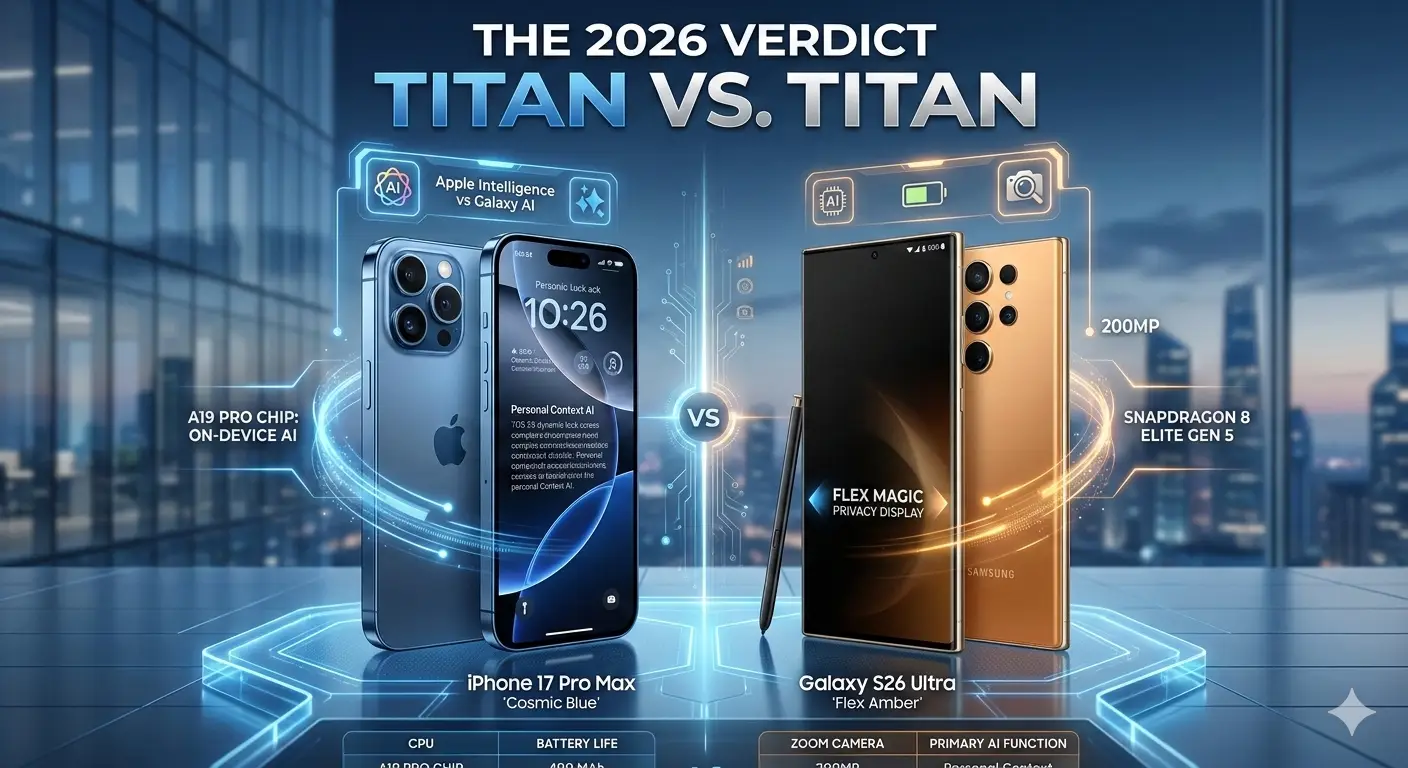

Discover the latest iPhone 17 Pro Max features and how they stack up against the Galaxy S26 Ultra. From the A19 Pro chip to Samsung’s Privacy Display, find out which 2026 flagship wins.
Table of Contents
In 2026, both companies moved away from their previous focus on titanium.
iPhone 17 Pro Max: Apple switched to a unibody aluminum frame made from aerospace-grade material. This change wasn't just for cost savings; it made it possible to include a large vapor chamber cooling system, which titanium couldn't handle efficiently. The result is a lighter phone that remains cool during 8K video editing.

Galaxy S26 Ultra: Samsung created its slimmest Ultra model yet at 7.9mm. It keeps the glass-and-metal design but softens the ergonomics with slightly curved edges. This makes the 6.9-inch frame much easier to hold than the boxy S24 and S25 models.
Display: Privacy vs. Purity
Both phones come with large 6.9-inch OLED screens, but their standout features are quite different.
The Samsung “Privacy Display”
The Galaxy S26 Ultra introduces Flex Magic Pixel technology. Samsung added narrow-angle pixels at the hardware level. When “Maximum Privacy Mode” is turned on, the screen nearly goes black if viewed from more than 30 degrees. This is the first flagship phone that offers built-in hardware privacy without needing a screen protector.
The Apple “Outdoor King”
Apple’s Super Retina XDR now reaches a sustained 3,000 nits in bright sunlight. Combined with Ceramic Shield 2, which includes a new anti-reflective coating, the iPhone 17 Pro Max achieves twice the outdoor contrast of its predecessor. It is simply the most readable screen ever designed for direct sunlight.
Camera Systems: 200MP vs. Triple 48MP
Camera Specifications: Samsung Galaxy S26 Ultra vs. iPhone 17 Pro Max
| Feature | Samsung Galaxy S26 Ultra | Apple iPhone 17 Pro Max |
| Main Sensor | 200MP ($f/1.4$) | 48MP ($f/1.78$) |
| Telephoto 1 | 10MP (3x Optical) | 48MP (4x Optical) |
| Telephoto 2 | 50MP (5x Optical) | N/A (Handled by 48MP Sensor Crop) |
| Ultra-Wide | 50MP | 48MP |
| Video Capabilities | 8K @ 30fps / APV Codec | 4K @ 120fps / ProRes RAW |
| Front Camera | 12MP | 18MP Center Stage |
The verdict on cameras: Samsung remains the leader in versatility. The dual-telephoto setup enables a 100x Space Zoom that is actually usable in 2026 because of AI denoising.
Apple focuses on professional workflows. The shift to a 48MP Telephoto allows for an "optical-quality" 8x zoom through sensor cropping. The new Dual Capture feature lets you record 4K video with both front and rear cameras at the same time—ideal for creators.Performance: A19 Pro vs. Snapdragon 8 Elite Gen 5
The gap between these processors has never been smaller. For the first time, Qualcomm’s Snapdragon 8 Elite Gen 5, built on a 3nm process, surpasses the Apple A19 Pro in raw multi-core benchmarks by about 10%.
Gaming: Samsung takes the lead in raw frame rates and ray-tracing performance.

Efficiency: Apple still holds the edge in "Performance-per-watt." The iPhone 17 Pro Max provides up to 39 hours of video playback, exceeding the S26 Ultra’s 5,000mAh battery due to better software integration.

RAM: Samsung offers up to 16GB, while Apple has finally increased to 12GB to support its on-device AI models.
The AI War: Apple Intelligence vs. Galaxy AI
The battle of 2026 centers on the Neural Engine.
Apple Intelligence: Focuses on personal context. Siri 2.0 can check your local files, texts, and emails to answer questions like, "When does my mom's flight land?" It prioritizes privacy, with most processing done on the A19 Pro chip.

Galaxy AI: Focuses on productivity and creativity. Samsung has integrated Gemini and Perplexity directly. New features like "Now Nudge" suggest actions based on what's on your screen (e.g., "Would you like me to book an Uber to the address in this text?").
Final Verdict: Which should you buy?
Choose the iPhone 17 Pro Max if:
You are a professional videographer needing ProRes RAW and Genlock support.

You want the longest battery life and the best resale value.

You prefer an AI that prioritizes your privacy and does not send your data to the cloud.
Choose the Galaxy S26 Ultra if:
You want the top zoom camera available.

You value display privacy for working in public.

You want the S Pen for productivity and the strength of the Snapdragon 8 Elite.