
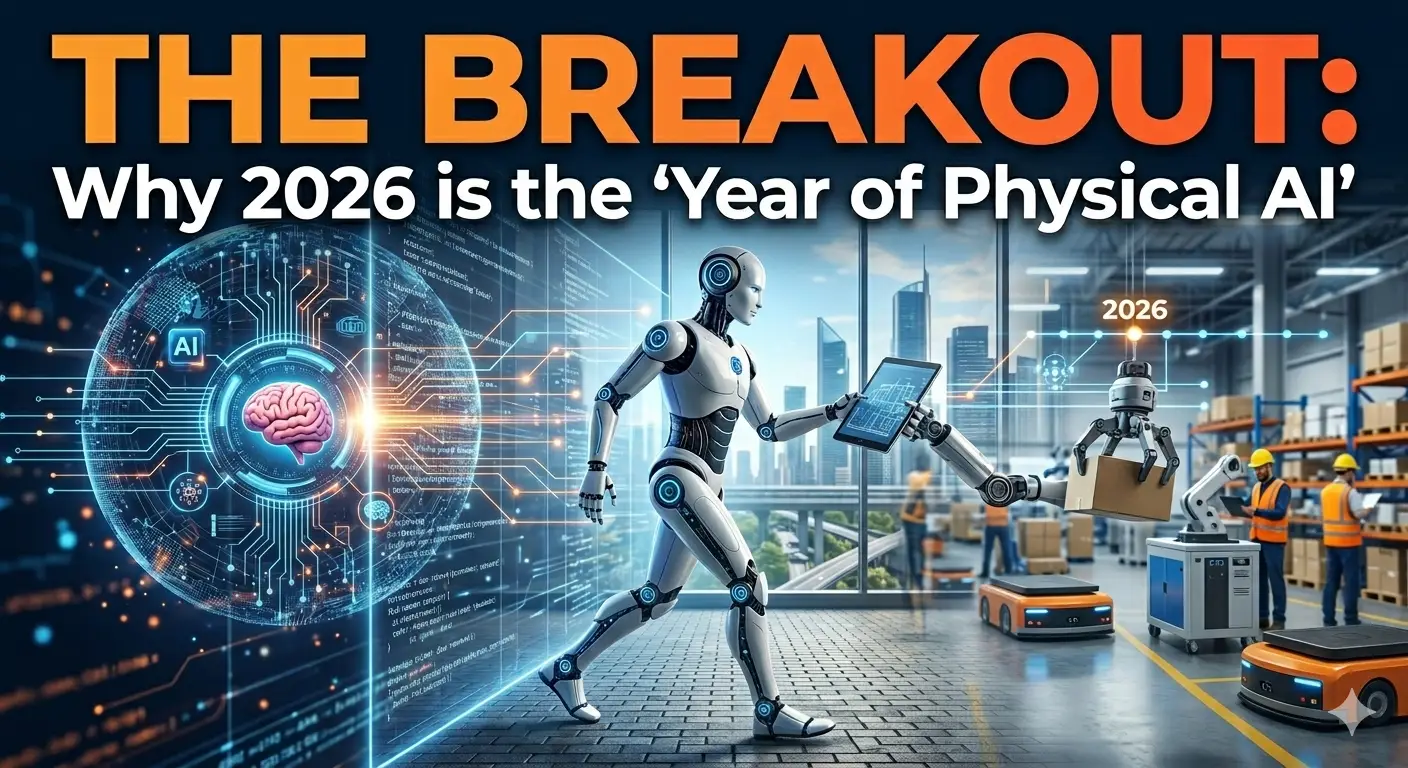

Discover why 2026 is the “Year of Physical AI.” From agentic workflows to humanoid robots and post-quantum security, explore the trends moving AI from screens to the real world.
SILICON VALLEY – For three years, the world watched AI through a glass screen. We chatted with it, generated art with it, and marveled as it wrote our emails. But as we cross the midpoint of the first quarter of 2026, the “Ghost in the Machine” has finally found its body.
Industry analysts are officially calling 2026 the “Year of Physical AI.” From the factory floors of the Midwest to the surgical suites of Tokyo, the era of purely digital assistants is being replaced by an Agentic Reality—where AI doesn’t just suggest; it acts.
1. From “Chatbots” to “Digital Employees”
The defining shift of early 2026 is the transition from generative models to Agentic AI. Unlike the chatbots of 2024, these “Agents” possess a cognitive cycle described by industry leaders as: Perceive, Reason, Act, and Learn.
- The Workflow Shift: Rather than responding to a single prompt, an AI Agent can now manage an entire multi-step project. If you tell an agent to “organize a business trip,” it no longer just lists flights; it checks your calendar, books the ticket, negotiates a corporate rate with the hotel, and files the expense report in real-time.
- The “Agentic” Enterprise: According to a February report from Wavestone, 40% of enterprise applications have transitioned to agentic patterns, moving AI from a “research pilot” to a core business operator.
2. The Humanoid Inflection Point
Perhaps the most visible sign of 2026’s tech boom is the sudden ubiquity of humanoid robots in commercial spaces. What were once clumsy prototypes at research labs are now “Reliable Partners” on the factory floor.
- The Production Race: Companies like Figure AI and Tesla have moved into the pilot-to-production phase. Tesla’s Optimus Gen 2 is now being deployed in limited factory roles, while startups like Unitree have democratized the field with bipedal robots priced as low as $16,000.
- General-Purpose Mobility: “We didn’t need a robot for a single task; we needed a robot for human spaces,” says a recent Deloitte tech report. Because these machines can navigate stairs and narrow aisles, they are being “onboarded” like new employees rather than installed like heavy machinery.
3. The Security Reckoning: Preparing for “Q-Day”
As our physical infrastructure—power grids, water systems, and logistics fleets—becomes managed by AI, the threat of cyber-attacks has escalated. 2026 has become the year of Post-Quantum Cryptography (PQC).
With quantum computers nearing the ability to crack traditional encryption, the “Sovereign AI” movement has gained massive momentum. Governments in the EU and North America are now mandating that critical AI infrastructure remain on local soil, using quantum-resistant “hybrid deployment models” to ensure that today’s data isn’t decrypted by tomorrow’s computers.
4. Hardware “Gets Weird”
While the smartphone remains a staple, 2026 is seeing the first true challenge to the “Black Mirror” slab.
- AI Wearables: Smart glasses (like the Meta-RayBan successors) are becoming the primary interface for AI. Users are opting for “Ambient Intelligence” that sees what they see and hears what they hear, providing real-time translations or recipe steps directly into their field of vision.
- On-Device AI (Edge AI): Privacy concerns have driven a shift toward Small Language Models (SLMs). New chips from Qualcomm and Apple allow your phone to run a powerful AI locally, meaning your data never leaves the device.
The 2026 Tech Pulse: At a Glance
| Trend | Market Status | Practical Impact |
| Agentic AI | Mass Adoption | AI handles end-to-end workflows (HR, Sales, Travel). |
| Humanoid Robots | Commercial Pilot | Robots performing “dull, dirty, or dangerous” labor. |
| Post-Quantum | Infrastructure Upgrade | Banks and Govts switching to quantum-safe security. |
| Sovereign AI | Legal Mandate | AI data must stay within national borders. |
The Verdict: A Human-Centric Future?
Despite the rapid automation, the mood in 2026 is surprisingly optimistic. A recent IBM study found that 61% of employees feel AI has made their jobs less mundane and more strategic. As machines take over the repetitive “doing,” humans are being elevated to the role of “Orchestrators.”
“We aren’t being replaced,” says one Silicon Valley CTO. “We’re finally being given the time to be human again.”